

How design, credibility and consumer psychology influence the way people evaluate businesses online.
You’ve probably visited a website and immediately felt that something was off. Maybe the photography looked suspiciously generic, the layout felt outdated or the contact information was buried somewhere beneath three paragraphs about the company’s commitment to excellence. Nothing necessarily indicated that the business was unreliable, but something about the experience made you hesitate.
Then there are websites that feel credible almost immediately. The information is organized, the branding is consistent, the photography feels authentic and it’s easy to understand who the business is, what they offer and how to contact them.
These reactions aren’t entirely accidental.
Website design influences how people perceive credibility, professionalism and trustworthiness, often before they’ve had an opportunity to evaluate a business in detail. Understanding the psychology behind these first impressions can help businesses create digital experiences that do more than look attractive. They can make potential customers feel confident enough to take the next step.
First Impressions Happen Before People Read the Details
Research into visual perception suggests that people can form initial impressions of website aesthetics remarkably quickly, sometimes within fractions of a second. These early reactions are influenced by visual characteristics such as layout, colour, typography, spacing and overall design consistency.
This doesn’t mean visitors can accurately determine whether a business is trustworthy in an instant. Rather, the visual presentation of a website can influence their initial perception before they’ve examined the actual information. Psychologists sometimes describe a related phenomenon as the halo effect, where a positive impression of one characteristic influences how someone evaluates other characteristics.
In a digital context, a polished and professional website may encourage visitors to perceive the business behind it more favourably. Of course, attractive design doesn’t guarantee a reputable company. But an inconsistent or poorly maintained website can create unnecessary doubt, particularly when customers are comparing several businesses offering similar services.
For businesses, this makes visual presentation an important part of credibility.
Your website doesn’t need to win a design award. It does, however, need to look like someone has checked on it since 2014.
Consistency Makes a Business Feel More Established
Consistency plays an important role in how people process information and recognize patterns. When a website uses a cohesive visual identity, visitors can more easily understand which elements belong together and how information is organized. Consistent typography, colour palettes, imagery, navigation and messaging create a sense of continuity throughout the browsing experience.
This can also extend beyond the website itself.
When a business presents a recognizable identity across its website, social media profiles, email communications and physical marketing materials, customers encounter a more unified brand experience. Inconsistent branding doesn’t automatically make a business untrustworthy, but noticeable differences can introduce uncertainty.
For example, a business whose website uses one logo, social media profile uses another and promotional materials feature an entirely different visual style may leave customers wondering whether they’re interacting with the same organization. Strong brand guidelines help reduce these inconsistencies by establishing clear standards for how a business should appear and communicate.
The objective isn’t to make every marketing material identical. It’s to make the business recognizable regardless of where customers encounter it. Preferably without requiring them to investigate whether three different logos belong to the same company.
Authentic Photography Can Make a Business More Believable
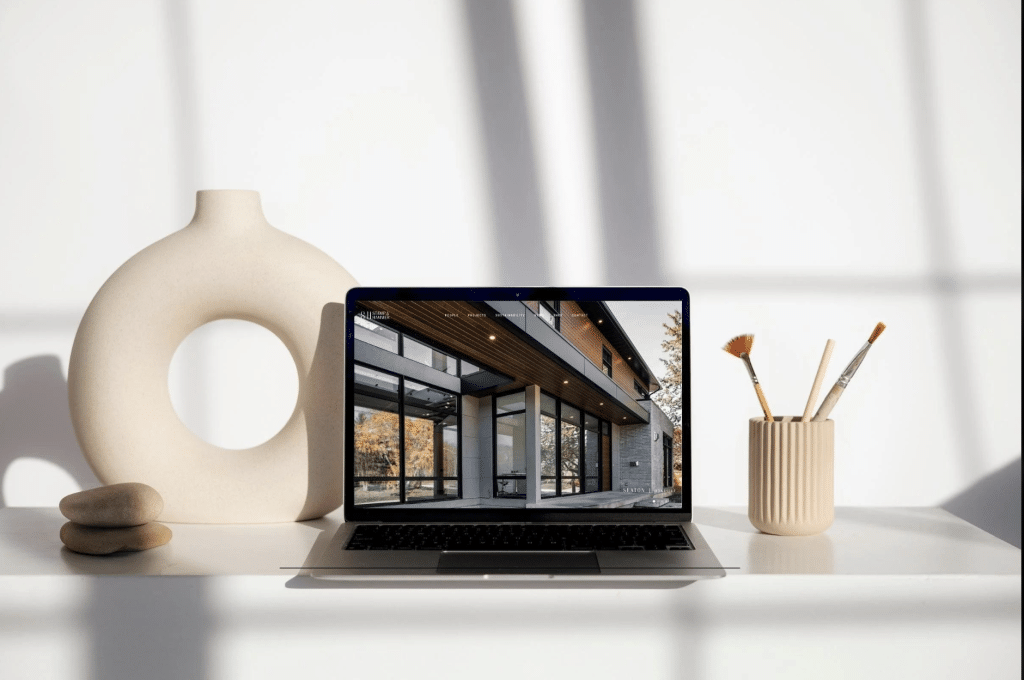
Photography is one of the most immediate ways a business communicates information about itself. Images can show customers what a product looks like, who they’ll be working with, what a facility offers or how a service is delivered.
When photography is authentic and relevant, it can help reduce uncertainty by giving visitors a clearer understanding of the business behind the website. Professional photography is particularly valuable for service based businesses, where customers may be making decisions based on expertise, relationships and the quality of previous work. Photographs of actual employees, completed projects, products and business environments can provide useful visual evidence that supports the company’s messaging.
Stock photography still has a place in digital design, but relying too heavily on generic imagery can make it difficult for a business to establish a distinctive identity. If five competing companies all feature the same photograph of four suspiciously enthusiastic people pointing at a laptop, none of them is communicating much about what makes their business different.
The goal isn’t simply to use better photographs. It’s to use imagery that helps customers understand what they’re actually choosing.
Transparency Reduces the Uncertainty Behind Purchasing Decisions
Trust is particularly important when customers are making decisions involving money, personal information or services they haven’t experienced before. When people evaluate a business online, they’re often trying to answer several practical questions.
Is this company legitimate?
Does it provide the service I need?
Can I understand the process?
What happens after I submit an inquiry?
Will I be able to contact someone if there’s a problem?
A website that answers these questions clearly can help reduce uncertainty and make the decision making process feel more manageable. Transparent information about services, pricing structures where appropriate, business locations, contact details, policies and processes can all contribute to a more reassuring experience. This is also why clear calls to action matter.
A button labelled “Get Started” may look perfectly acceptable, but it doesn’t necessarily explain what happens next. Will the visitor be asked to book a consultation, complete a form, make a payment or create an account? Providing context can help visitors understand what they’re agreeing to before they take action. Businesses sometimes assume that withholding details will encourage people to contact them for more information. In reality, unnecessary uncertainty may simply encourage visitors to continue researching elsewhere.
Mystery is excellent for novels. It’s considerably less appealing when someone is trying to understand your cancellation policy.
Social Proof Helps Customers Evaluate Their Decisions
People frequently look to the experiences of others when deciding whether to trust an unfamiliar business. This behaviour is associated with the psychological concept of social proof, where individuals use information about other people’s actions or experiences to help guide their own decisions.
For websites, social proof can appear in several forms, including customer reviews, testimonials, case studies, project portfolios and examples of previous work. These elements can provide context beyond what a business says about itself; a company describing its services as exceptional is making a claim, a detailed customer testimonial explaining how the company handled a difficult project provides a different kind of information. However, credibility depends on authenticity.
Generic testimonials without meaningful detail may be less persuasive than specific feedback describing an actual experience. Similarly, exaggerated claims, misleading review presentations or fabricated endorsements can undermine the very trust they’re intended to create. Case studies can be particularly valuable because they allow businesses to explain the challenges, decisions and outcomes associated with their work. Rather than simply announcing that a project was successful, they show potential customers what success looked like and how it was achieved. And unlike a paragraph describing your company as “industry leading,” actual examples give people something they can evaluate for themselves.
The Small Details That Make a Website Feel Reliable
Website credibility isn’t determined by visual design alone. Technical performance and functionality also influence how comfortable people feel interacting with a business online.
Broken links, outdated information, forms that don’t work and pages that behave unpredictably can create frustration and raise questions about how carefully the website is maintained. Security also matters, particularly when visitors are submitting personal information or completing purchases.
HTTPS helps protect information transmitted between a user’s browser and a website, while secure payment processes and responsible data handling are essential considerations for businesses collecting sensitive information. However, HTTPS alone does not prove that a business is legitimate. Trust depends on the broader experience, including how clearly a business communicates and how reliably its website functions.
Mobile usability is another important factor. A website that works beautifully on a desktop but becomes difficult to navigate on a phone can create unnecessary barriers for visitors.
These details may not always receive the same attention as branding or photography, but they contribute to the overall impression of professionalism. People may not notice when every link works, every form behaves correctly and every page loads as expected.
They will almost certainly notice when those things don’t.
Trust Is Built Through the Entire Digital Experience
A website’s first impression can influence whether someone decides to explore further, but lasting trust develops through a combination of clear communication, consistent branding, authentic information and reliable functionality. Businesses shouldn’t approach website design as an exercise in simply appearing trustworthy. The objective should be to communicate genuine credibility through an experience that helps visitors make informed decisions.
This means investing in more than attractive visuals. It requires thoughtful content, transparent information, professional photography, accessible design and technical development that supports the needs of real users.
At Kleurvision, we understand that effective website design involves both visual communication and the psychology of how people interact with digital environments. By bringing branding, content, design and development together, businesses can create websites that feel cohesive, professional and easier to trust.
Convincing someone to visit your website is only the beginning.. giving them a reason to stay, believe what they’re reading and feel comfortable contacting you is where the real work happens.

